







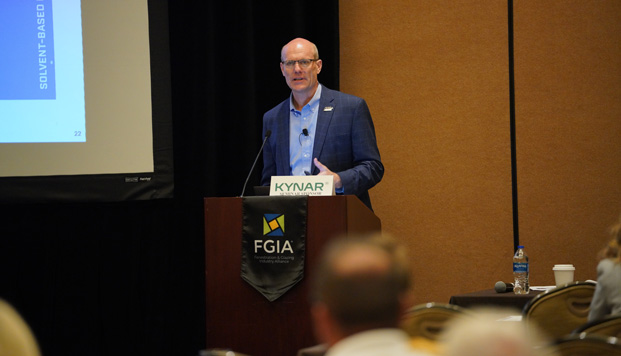
A seminar sponsored by Kynar at the Fenestration and Glazing Industry Alliance (FGIA) Annual Conference provided an overview of Polyvinylidene Fluoride (PVDF)-based coatings, examining how they deliver quality appearance while meeting durability requirements, including AAMA 2605. Paul Lavallee, Global Market Manager at Kynar, presented “Per- and Polyfluoroalkyl Substances (PFAS) and Paint: The Role of PVDF Finishes.” This session highlighted the PFAS landscape and how PVDF fits within the broader PFAS conversation.
Coatings Performance
Since PVDF coatings absorb very little UV, they continue to provide durability, integrity and protection for many years, Lavallee said, with high performance for chalking resistance, gloss retention and color retention. “Outdoor weathering is most common for PVDF,” said Lavallee. “We test in South Florida, at a 45-degree angle facing south. We also do some testing in Arizona. It takes a long time, as AAMA 2605 calls for 10 years in South Florida. So, we also do accelerated weathering with UV light.” He noted that there is similar color retention of solvent-based and water-based PVDF coatings after 25 years of Florida weathering.
PFAS Classifications
PFAS classifications can be broad, said Lavallee, adding that it is important to understand the differences between the characteristics and impacts of the sub-classifications of these substances. To that end, according to a research study by the American Chemistry Council’s Performance Fluoropolymer Partnership, PVDF meets the criteria for “polymer of low concern” as defined by the Organization for Economic Co-operation and Development (OECD).
“There is no one definition of PFAS, as it varies by country and jurisdiction,” said Lavallee. “Some are very broad and can lead to unintended consequences when it comes to regulations.”
PFAS Regulations
Currently, there are no federal regulations or bans on fluoropolymers. Some states have PFAS regulations in place, but they predominantly target consumer and personal use applications. New Mexico and Ohio consider fluoropolymers to be separate from other PFAS because of their structural difference and their uses and, therefore, have PFAS regulations from which fluoropolymers are exempt.
For more information about FGIA Events, visit FGIAonline.org/Events.
Your trusted industry resource, setting the standards for fenestration and glazing.
